It’s been another busy weekend at the bench on Nb Loveday. Stewart and I sat side-by-side with a brew on the go, working on pieces for a small commission, but more about that in a later post!
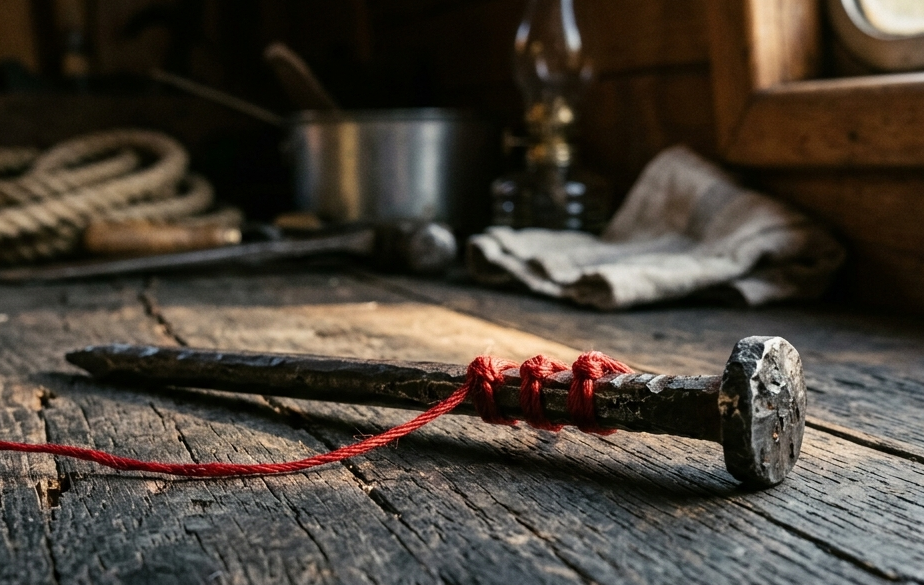
While we worked together in the close warmth of the boat, I began sharing my ongoing research into Italian folklore: specifically Il filo rosso, the red thread. As I explained the old stories and the quiet ritual of La Legatura, I realised Stewart had stopped his work entirely. He listened intently. The stories transfixed him.
Growing up visiting my Piemontese grandparents in Turin, the “kitchen laws” usually dictated what you didn’t do. You didn’t turn the bread upside-down. You didn’t spill the salt. You didn’t waste what had been given.
Ultimately, looking more closely at the traditions of Piemonte and the wider north, did I recognise the deeper meaning behind those small gestures: the ancient idea of binding protection in place.
This was La Legatura.
The Ritual of La Legatura
In northern traditions, a simple twist of red wool or silk fixes protection to a place or object. For instance, ribbon might wrap around a ladle, a bedpost, or a garden gate. It stays hidden at the threshold of the home, not displayed, not explained, simply present.
Similarly, this ritual often felt practical and domestic. A sturdy knot around a wooden spoon or a pair of shears marked the tool as belonging to the hearth. Consequently, it created a quiet boundary: this object belongs to this home’s abundance.
At other times, people tied the thread tied more deliberately as part of Le Segnature, the old “signings” known across Piemonte, Lombardy, and the Veneto. Grandmothers passed these whispered traditions quietly to granddaughters, often on Christmas Eve. Because of this secrecy, these traditions lived in memory rather than on paper.
Within these northern traditions, people fixed protection using three knots. Since three is the sacred number, it carries a specific weight. When someone “signs” a thread for protection, three knots lock the intention in place:
- one for the past
- one for the present
- one for the future
Not decoration, but binding.